
Each January, Clean Air Night prompts a renewed focus on air pollution and its impacts on health. This year’s campaign, taking place on 22nd January, has once again brought domestic burning into the spotlight.
Air quality is an issue that matters deeply — and the Stove Industry Association (SIA) agrees that reducing emissions must remain a priority. But meaningful progress depends on recognising an important truth: not all wood burning is the same, and real-world emissions are shaped by a combination of technology, fuel quality, installation, maintenance and user behaviour.
That’s why, alongside Clean Air Night, the SIA is launching a short, practical consumer-education campaign focused on what actually makes a difference – #PositiveWoodburning.
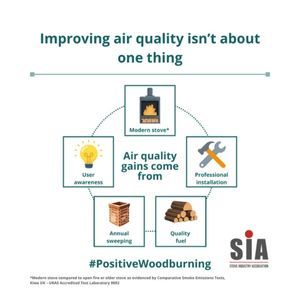
Moving beyond oversimplification
Much of the public debate around domestic burning tends to treat all appliances and all use as identical. In reality, emissions vary widely depending on:
- the appliance being used
- the fuel that is burned
- how the appliance is operated
- how well it is maintained
Over the past decade, the UK stove sector has undergone significant change. Open fires and very old appliances — which are the highest-emitting forms of domestic solid fuel use — are no longer representative of the products placed on the market today. Modern stoves must meet strict emissions and efficiency standards to comply with UK law, and manufacturers continue to invest heavily in improved combustion and performance.
Understanding air quality in context
It is also important to recognise that domestic wood burning is not the sole cause of poor air quality in the UK, nor is it responsible for all particulate pollution experienced in towns and cities.
Air pollution comes from a wide range of sources, including:
- road transport and non-exhaust vehicle emissions
- construction activity
- agriculture
- industrial processes
- commercial and domestic combustion across multiple fuel types including outdoor burning of green waste in bonfires and firepits and on allotments
- transboundary emissions, wildfires etc.
Levels of air pollution also vary significantly depending on location, weather conditions, population density and time of year.
Domestic wood burning is one contributor within this wider picture, which is why effective policy and public discussion must be proportionate and evidence-led, focusing on the sources, technologies and behaviours where the greatest improvements can be achieved.
Treating all air quality challenges as the result of a single activity risks oversimplifying a complex issue — and can divert attention away from practical, targeted measures that are already delivering emissions reductions in the real world.
Why consumer behaviour matters
Regulation alone is not enough. How people use their appliances matters too.
Independent data shows that poor fuel quality, incorrect lighting techniques, over-loading, slumbering stoves and lack of maintenance can all significantly increase emissions.
The SIA’s focus, therefore, is not on denying air-quality concerns, but on helping households reduce emissions in practice through better choices and better use. Encouragingly, official statistics already show progress: emissions of PM2.5 and PM10 from domestic combustion fell by 17% between 2020 and 2023, reflecting a combination of regulation, product innovation and improved awareness. (Source: www.gov.uk/government/statistics/emissions-of-air-pollutants/emissions-of-air-pollutants-in-the-uk-summary)
This progress demonstrates that change works when it is targeted and evidence-led.
What the SIA campaign focuses on
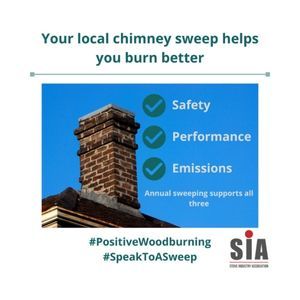
Running between 15th and 25th January, the SIA’s #PositiveWoodburning campaign highlights five areas where households can make a tangible difference:
- Choosing modern, regulated appliances
Modern Ecodesign-compliant stoves are designed to burn fuel far more efficiently than open fires or older appliances, delivering more heat to the room while using less fuel. - Professional installation
Correct installation by competent professionals helps ensure appliances operate as intended, supporting both safety and emissions performance. - Using quality fuel
Burning dry, well-seasoned wood with a moisture content below 20% — ideally 10–15% — is one of the simplest and most effective ways to reduce smoke. - Lighting and refuelling correctly
Techniques such as top-down lighting, avoiding over-loading, and refuelling carefully all support cleaner combustion. - Regular chimney sweeping
Annual sweeping supports safety, performance and emissions reduction, with chimney sweeps playing a vital advisory role for households.
Together, these measures represent practical, achievable steps that can significantly reduce emissions associated with domestic wood burning.
A regulated, forward-looking sector
The UK stove industry is already one of the most tightly regulated domestic heating sectors, and it continues to evolve. Emissions limits have tightened, testing requirements have increased, and manufacturers are actively developing the next generation of appliances.
This winter, the SIA’s message is simple: Air quality matters. How we burn matters too.
Improving air quality is not about oversimplifying complex issues or framing households as the problem. It is about supporting informed choices, proportionate policy, and continued progress — all of which are essential if emissions reductions are to be sustained.
Call to action
Households looking for advice on improving how they burn should speak to their local stove retailer or chimney sweep, and follow manufacturer guidance and fuel standards.
By focusing on evidence, education and best practice, we can continue to make real, measurable improvements to air quality — not just on Clean Air Night, but all year round.
Article and images courtesy of the Stove Industry Association (SIA).